Cybercriminals are becoming more strategic, targeting individuals and organizations through deception, financial manipulation and social engineering. From business email compromise to AI-generated impersonation, today’s scams are more sophisticated, more convincing and more damaging than ever. These attacks exploit personal data, workplace systems and everyday routines, creating serious vulnerabilities across teams and operations. The financial and reputational impacts can be significant, making cybersecurity awareness and preparedness essential to organizational resilience.
One Agency, Two Missions: The U.S. Secret Service (USSS)
While widely recognized for protecting national leaders, the U.S. Secret Service (USSS) also plays a vital role in safeguarding the nation’s financial infrastructure. The agency is deeply involved in cyber investigations and financial crime prevention, working to secure major national events, share threat assessment expertise, and protect the integrity of U.S. currency and financial systems. Through its Cyber Fraud Task Force (CFTF), the USSS aims to prevent, detect and disrupt complex cyber-enabled financial crimes.
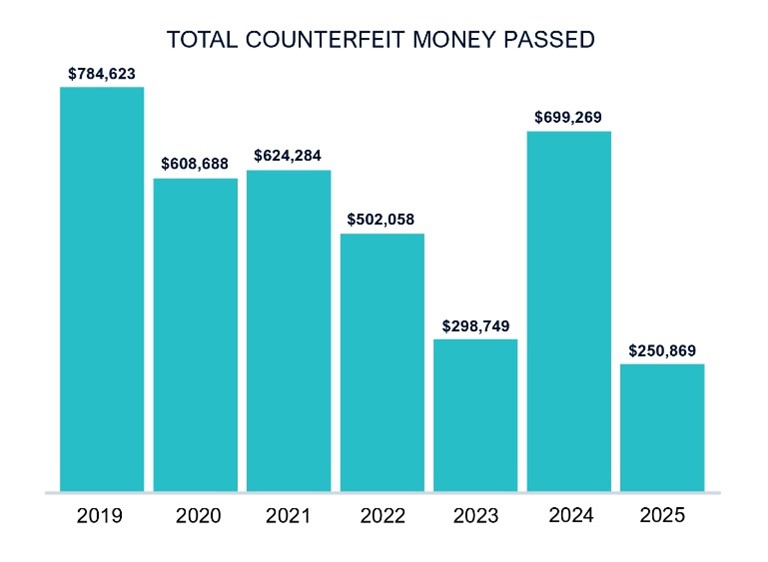
Counterfeit Activity – Cleveland, OH (2019–2025): Counterfeit currency passed peaked in 2019 and, apart from 2024, has declined steadily through 2025.
Common Cyber Crimes Investigated by the USSS
- Access Device Fraud
- Point-of-Sale System Compromise
- ATM Attacks and Network Intrusions
- Ransomware and Illicit Financing Operations
- Identity Theft and Business Email Compromise (BEC)
Current Cyber Fraud Trends
Modern scams exploit both technology and human psychology. Some of the most prevalent and damaging schemes today include:
- Business Email Compromise (BEC): Threat actors intercept privileged communications, compromise email accounts, exploit information and redirect funds.
- The U.S. Secret Service (USSS) has helped save an estimated $228 million since 2019 by combatting BEC attacks through public-private partnerships, Cyber Fraud Task Forces (CFTFs) and coordination with law enforcement.
- Tech Support Scams: Victims are tricked into believing their systems are infected, creating false urgency and leading them to install remote-access software that exposes personal data.
- Romance Scams: Scammers build emotional relationships over time, eventually manipulating victims into sending money or becoming accomplices.
- Pig Butchering: A fast-growing cryptocurrency scam where victims are lured into fake investment schemes after trust is established.
The Role of AI in Cyber Fraud
AI is increasingly used to enhance cyber scams. Common tactics include:
- Executive Impersonation: Deepfake technology combined with authentic data to mimic leadership figures.
- Phishing Emails & Texts: AI-generated messages containing malicious links or attachments.
- Elder Fraud: Voice cloning of family members to exploit the trust and emotions of older adults.
Protecting Yourself Against Cyber Threats
- Passwords: Update regularly and utilize multi-factor authentication (MFA).
- Software & Apps: Install updates promptly, use trusted sources and adjust social media privacy settings.
- Remote Access Checks: Use task manager to check access, monitor pop-ups and firewall settings, and conduct regular scans
- Travel Connectivity: Use unique passwords, avoid public Wi-Fi and charging stations, and consider using a VPN
- Social Engineering & Phishing: Report suspicious messages as spam and clicking unknown links
Organizational Cyber Preparedness
The question is no longer if an incident will occur, but when. A proactive approach includes:
- Clarifying legal responsibilities and establishing strong partnerships.
- Enhancing cyber awareness across your organization and regularly conducting vulnerability assessments.
- Implementing robust cybersecurity measures and continuous network monitoring.
- Developing a comprehensive employee training program & a clear communication strategy.
- Creating and maintaining a formal Incident Response (IR) Plan to help guide recovery.
USSS Incident Response
The U.S. Secret Service plays a critical role in supporting organizations during cyber incidents. Their involvement includes:
- Collaborating with your Incident Response team
- Comparing indicators with other cases and benchmarking data
- Coordinating with the U.S. Attorney’s Office and law enforcement partners
- Assisting with media, staff and customer briefings
While the USSS provides valuable support, their primary goal is to track down and prosecute bad actors. They do not serve as legal counsel, public relations representatives or business continuity planners.
Questions? Reach Out to an Advisor.
Cyber threats are constantly evolving, and so should your response. Our advisors work closely with organizations to strengthen cybersecurity practices and align them with long-term business goals, enhancing resilience in a rapidly changing threat landscape. Contact us today to learn more.